Defending Life: A Moral and Legal Case against Abortion Choice by Beckwith Francis J
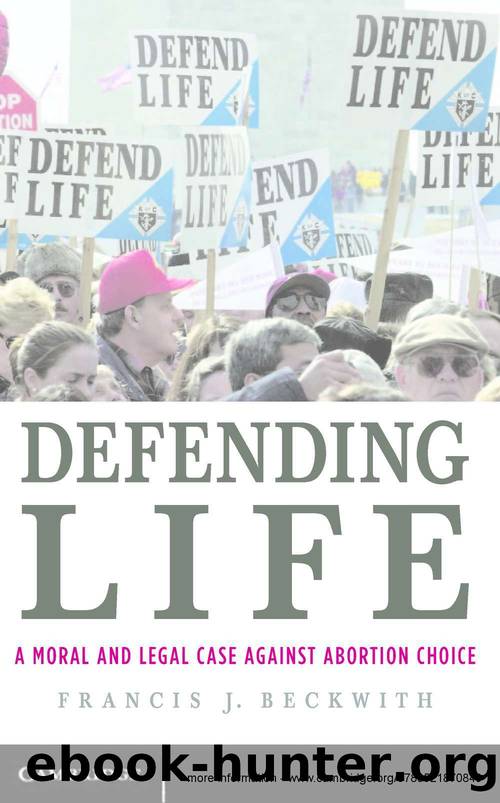
Author:Beckwith, Francis J. [Beckwith, Francis J.]
Language: eng
Format: epub
Publisher: Cambridge University Press
Published: 2007-08-12T16:00:00+00:00
There is widespread disagreement on the issue of forbidding abortion.
Therefore, any law that forbids people to have abortions is unjust.
Because I critique Judith Jarvis Thomson’s sophisticated version of this argument in Chapter 3 , I will offer here a response only to this more generic version of the argument.
Premise (1) is clearly false, a judgment for which I offer five reasons. First, if (1) is true, then the abortion-choice advocate must admit that the United States Supreme Court decision, Roe v. Wade , is an unjust decision, because the Court ruled that the states that make up the United States, whose statutes prior to the ruling disagreed on the abortion issue, must behave uniformly in accordance with the Court’s decision. If, however, the abortion-choice advocate denies that Roe was an unjust decision, then he is conceding that it is false that “there can never be a just law requiring uniformity of behavior on any issue on which there is widespread disagreement.” Second, if (1) is true, then the abolition of slavery was unjust because there was widespread disagreement of opinion among Americans in the 19th century. Yet nobody would say that slavery should have remained as an institution. Third, if (1) is true, then much of civil rights legislation, about which there was much disagreement, would have been unjust. Fourth, if (1) is true, then a favorite abortion-choice public policy proposal is also unjust. Some abortion-choice advocates believe that the federal and/or state government should use the tax dollars of the American people to fund the abortions of poor women. There are large numbers of Americans, however, some of whom support abortion choice, who do not want their tax dollars used in this way. And fifth, if (1) is true, then laws forbidding pro-life advocates from preventing their unborn neighbors from being aborted would be unjust. One cannot say that there is not widespread disagreement concerning this issue. But these are the very laws the abortion-choice advocate supports. Hence, this argument is self-refuting, since by legislating the abortion-choice perspective the government is “requiring uniformity of behavior on an issue on which there is widespread disagreement.” That is to say, the abortion-choice advocate is forcing the pro-lifer to act as if her view of prenatal life is false. By making “no law,” the government is implicitly affirming the view that the unborn are not fully human, which is hardly a neutral position.
Argument from the Impossibility of Legally Stopping Abortion
Maybe the defender of the above argument is making the more subtle point that because there is widespread disagreement on the abortion issue, enforcement of any laws prohibiting abortion would be difficult. In other words, abortions are going to happen anyway, so we ought to make them safe and legal. There are several problems with this argument.
First, it begs the question, because it assumes that the unborn is not fully human. For if the unborn is fully human, this argument is tantamount to saying that because people will unjustly kill other people anyway, we ought to make it safe and legal for them to do so.
Download
This site does not store any files on its server. We only index and link to content provided by other sites. Please contact the content providers to delete copyright contents if any and email us, we'll remove relevant links or contents immediately.
| Anthropology | Archaeology |
| Philosophy | Politics & Government |
| Social Sciences | Sociology |
| Women's Studies |
The remains of the day by Kazuo Ishiguro(9016)
Tools of Titans by Timothy Ferriss(8418)
Giovanni's Room by James Baldwin(7363)
The Black Swan by Nassim Nicholas Taleb(7145)
Inner Engineering: A Yogi's Guide to Joy by Sadhguru(6806)
The Way of Zen by Alan W. Watts(6625)
The Power of Now: A Guide to Spiritual Enlightenment by Eckhart Tolle(5803)
Asking the Right Questions: A Guide to Critical Thinking by M. Neil Browne & Stuart M. Keeley(5789)
The Six Wives Of Henry VIII (WOMEN IN HISTORY) by Fraser Antonia(5523)
Astrophysics for People in a Hurry by Neil DeGrasse Tyson(5197)
Housekeeping by Marilynne Robinson(4462)
12 Rules for Life by Jordan B. Peterson(4316)
Ikigai by Héctor García & Francesc Miralles(4286)
Double Down (Diary of a Wimpy Kid Book 11) by Jeff Kinney(4285)
The Ethical Slut by Janet W. Hardy(4271)
Skin in the Game by Nassim Nicholas Taleb(4265)
The Art of Happiness by The Dalai Lama(4139)
Skin in the Game: Hidden Asymmetries in Daily Life by Nassim Nicholas Taleb(4021)
Walking by Henry David Thoreau(3973)
